


If you’ve noticed your eyes looking heavier or more hooded lately, you’re probably focused on what you can add to your routine — a new eye cream, a serum, maybe a tool you saw online.
But before we talk about what to add, it’s worth looking at what might already be working against you.
Some of the most common daily habits quietly accelerate changes around the eye area — and most women have no idea they’re doing them. The good news is that once you’re aware, they’re surprisingly easy to shift.
Here are five worth knowing about — and what to do instead.
1. Squinting in the sun
The skin around your eyes is the thinnest on your entire body, which makes it especially vulnerable to UV damage. UV rays break down collagen and elastin — the proteins responsible for keeping skin firm and resilient. Years of squinting in bright light, even on overcast days, accelerates this process more than most people realise.
What to do instead: Wear sunglasses with proper UV protection consistently — not just at the beach, but on your daily commute, during errands, any time you’re outdoors. Pair them with SPF applied carefully around the orbital bone for extra protection.
2. Rubbing your eyes
It’s a reflex most of us don’t even notice — at the end of a long day, when we’re tired, or when removing makeup at night. But repeatedly pulling and tugging the delicate eyelid skin gradually stretches it over time, contributing to that heavy, drooping appearance.
What to do instead: When removing eye makeup, press a soaked cotton pad gently against the eye and hold for a few seconds before wiping — always downward, never sideways. For the itching or tiredness reflex, try gently pressing the heels of your hands against your closed eyes instead of rubbing. It relieves the sensation without the drag on the skin.
3. Sleeping face-down or on your side
Your sleep position matters more than you might think. Sleeping with your face pressed into a pillow causes overnight fluid buildup and skin creasing around the eye area. Over time, consistently compressing the same side of your face can contribute to puffiness that doesn’t fully clear during the day and asymmetry between the two eyes.
What to do instead: Sleeping on your back is the most protective position for the face and eye area. If that feels impossible right now, a silk or satin pillowcase is a meaningful upgrade — it creates far less friction and pulling on the skin than cotton, and reduces the creasing that builds up over years of side sleeping.
4. Not drinking enough water
Because the skin around the eyes is so thin, it shows dehydration faster than anywhere else on the face. When skin lacks adequate hydration it loses plumpness and elasticity, making the eye area look more sunken, creased, and heavy — even when you’ve had a full night’s sleep.
What to do instead: Start your morning with a large glass of water before coffee. Consistent hydration is one of the most underrated things you can do for skin health. Foods rich in antioxidants — colourful vegetables, berries, omega-3 fatty acids — also support skin elasticity from the inside out.
5. Using your forehead to open your eyes
This one surprises most people — and it’s the habit I find most important to talk about.
Many of us unconsciously recruit the forehead muscles to help open our eyes, especially as the muscles around the eye and brow area naturally weaken over time. You can test this right now: place your fingers lightly on your forehead and open your eyes wide. If you feel movement underneath your fingertips, your forehead is doing work it shouldn’t be.
Over time, this pattern contributes to brow descent — one of the main reasons the upper eyelid starts to look heavy and hooded. It also creates horizontal forehead lines as a side effect of the constant overuse.
What to do instead: Start bringing awareness to this habit throughout the day. When you catch yourself raising your brows to open your eyes — at your screen, in conversation, in the mirror — pause and try to relax the forehead while keeping the eyes open. The exercise below will help you retrain this pattern with intention.
Where to start: two Face Yoga movements for the eye area
Awareness of the habits above is the first step. But the muscles around the eye and brow area also respond well to gentle, targeted movement — the same way muscles anywhere in the body do when given consistent attention.
Here are two of my favourite beginner movements for the eye area.
The Forehead Freeze
This movement trains your eye muscles to work independently from your forehead — directly addressing habit number five above.
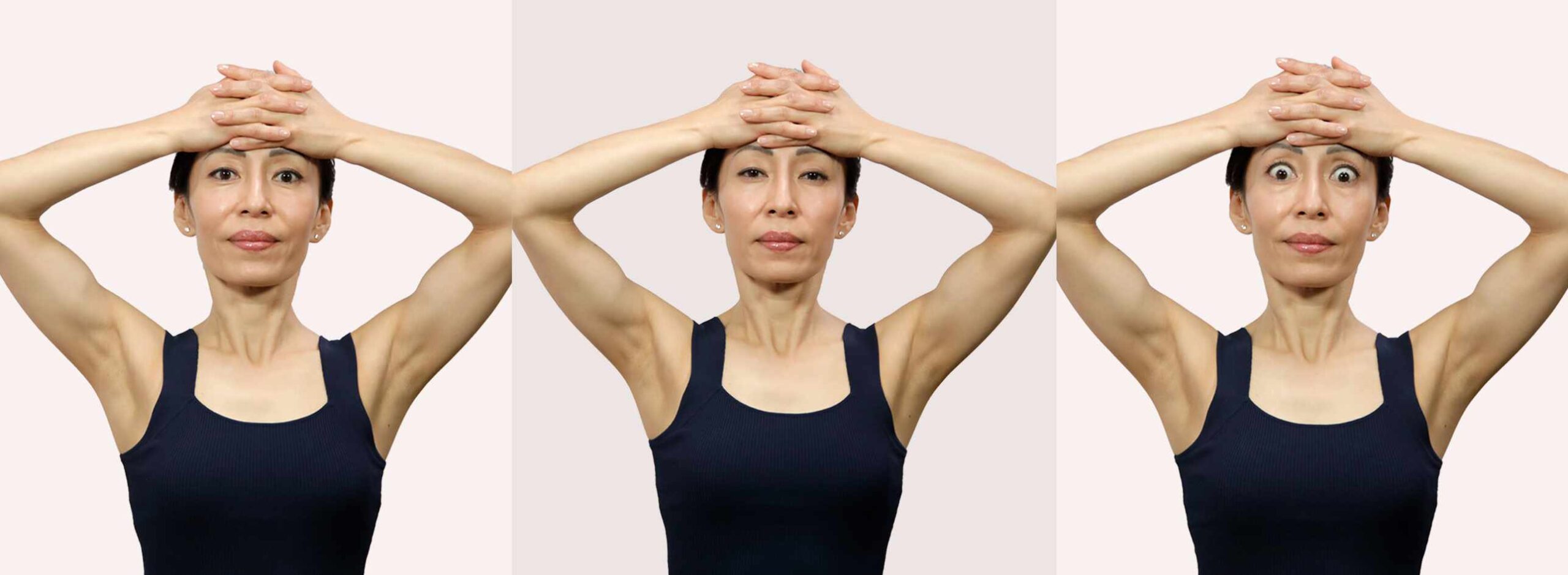
- Sit tall, relax your neck and shoulders, and breathe in and out through your nose.
- Interlace your fingers and place your palms flat against your forehead.
- Close your eyes and relax for 3 seconds.
- Now open your eyes as wide as possible — without letting your forehead move against your hands.
- Hold for 10 seconds. Release and relax.
Do 2 sets. You’ll likely notice how much you normally rely on your forehead to open your eyes. That awareness alone is a powerful starting point.
The Eye Bag Toner
This movement targets the under-eye area and stimulates circulation — particularly helpful if puffiness and heaviness are your main concerns.
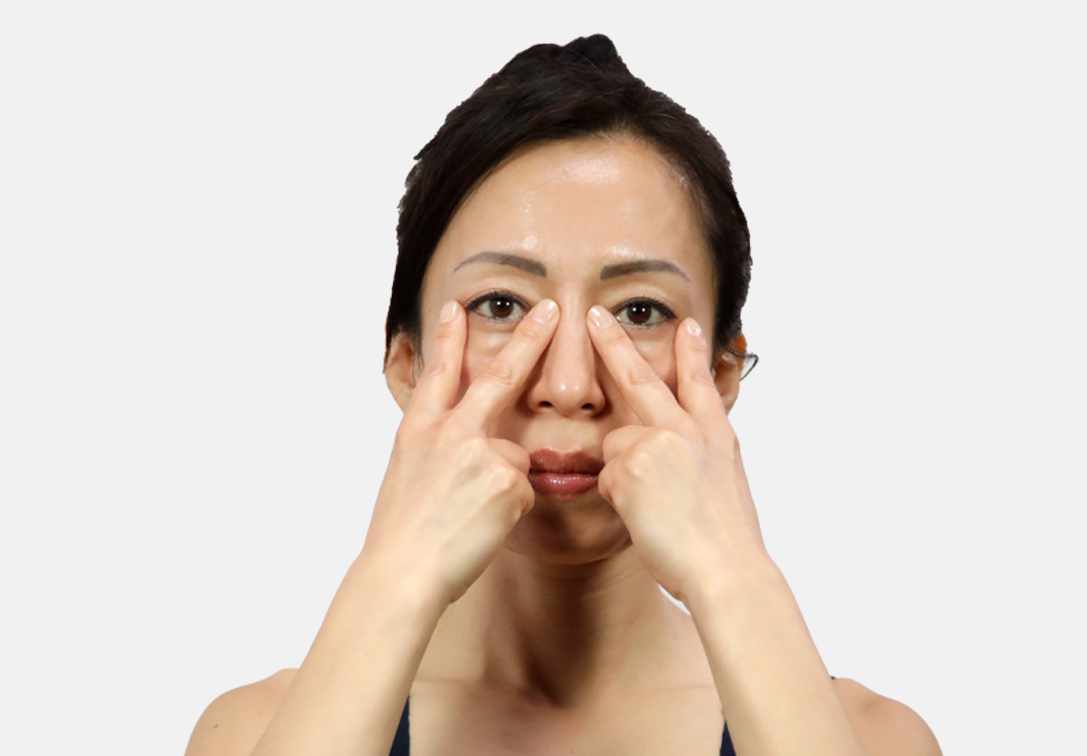
- Sit tall, relax your neck and shoulders, and breathe through your nose.
- Place your middle fingers at the innermost corners of your eyes and your index fingers at the outermost corners. Apply slight pressure.
- Look straight ahead and relax your forehead completely.
- Open your mouth by dropping your jaw into an “O” shape, and press your upper lip gently against your teeth.
- Gaze upward at a 45-degree angle.
- Squint using your lower eyelids only and hold for 10 seconds.
- Close your eyes and mouth for 3 seconds. Release and relax.
Do 3 sets. Keep the forehead relaxed throughout — let the muscles around the eyes do all the work.
Worth remembering
None of these habits are things to feel bad about. Most develop completely unconsciously, and simply becoming aware of them puts you ahead of where most people are.
Small, consistent changes — to how you treat the eye area daily and how you move the muscles around it — can make a real difference over time. Not overnight, but in a way that builds and lasts.



Thank you. Very useful. I was wondering if you have a recommendation for after a long time looking at the screen. I’ve noticed a visible impact – eye fatigue and darker under the eyes. Also, I cannot make Apr 23, but I’d appreciate a link to the recording, if possible. Thank you
No worries! A replay will be sent to you when you register. It will be available for 48hrs for you to watch. Make sure to sign up to get it! ❤️
Hello, I don’t *do* zoom…how can I watch the replay or the purchased programme?
Hi Sharyn, no worries! We’ve got you covered. You can watch the replay now here: https://bit.ly/4u86LBj