Botox is the most commonly performed cosmetic procedure in the world. Face yoga is a practice that works on the same muscles — from the inside, without injections. Understanding how they compare requires looking at what each one actually does to the face, not just what results they produce.
This post covers the mechanism of each, what the research shows, and the question many people arrive at eventually: can you do face yoga if you’ve already had Botox?
I’ll be honest — I smile every time I see comments on social media suggesting I must have had Botox. I get it. I’m in my 50s, I’ve been doing face yoga for over 22 years, and people are genuinely surprised that the results come from a practice rather than a procedure.
No Botox, no fillers, no surgery. Just face yoga — consistently.
What Botox Does — and What It Doesn’t
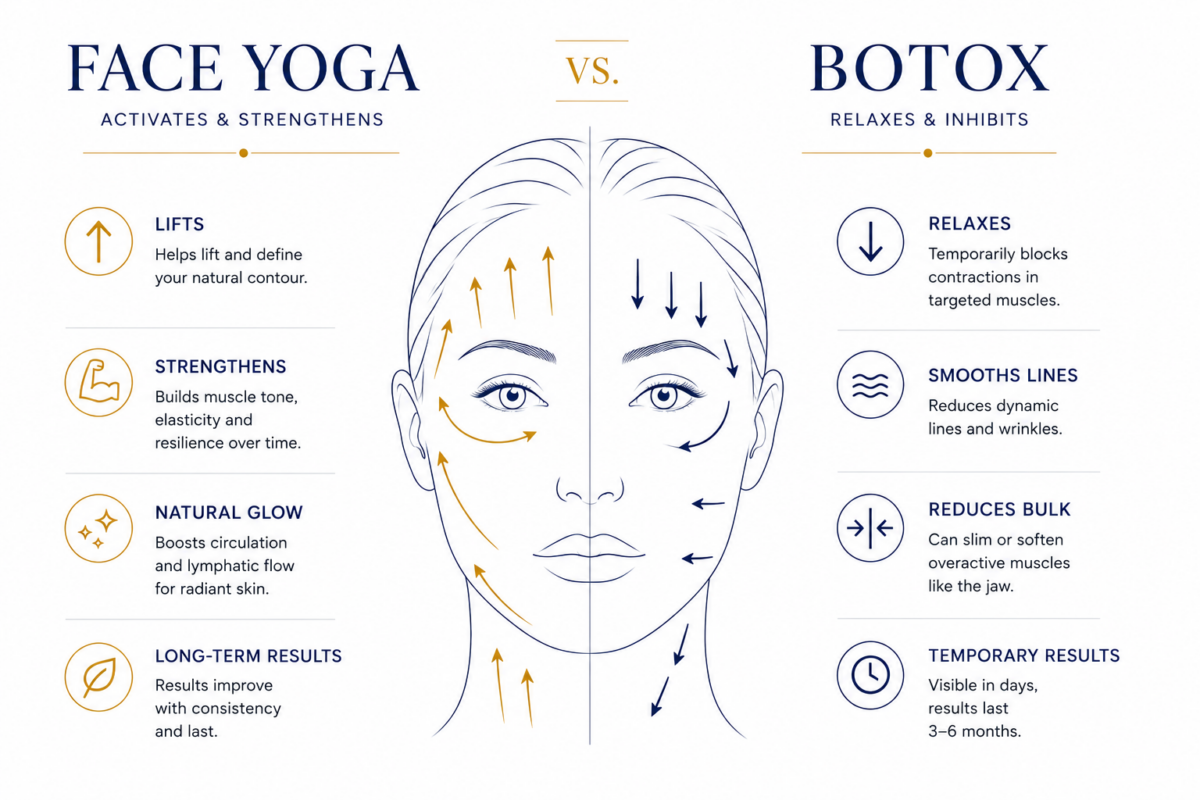
Botox (botulinum toxin type A) works by blocking the nerve signals that trigger muscle contraction at the injection site. The muscle is temporarily paralysed — typically for three to six months — which prevents it from creating the expression lines that develop over time.
The results are immediate and predictable. For someone with deep dynamic wrinkles — lines caused by repeated muscle movement — Botox produces a visible reduction within days.
What Botox does not do is address the structural cause of facial aging. The facial muscles — there are over 50 of them — lose volume and tone with age, just like the muscles of the body. When they weaken and descend, the overlying skin descends with them. Botox temporarily freezes movement but doesn’t rebuild the muscular foundation underneath. When the paralysis wears off, the muscle returns to exactly the same state — or, with repeated long-term use, potentially weaker from disuse.
A less-discussed mechanical consequence: a muscle that is paralysed and not used will lose volume and can sag downward under gravity. This is why a droopy eyelid is a known side effect of Botox injections above the eyebrow — the frontalis muscle, now paralysed or partly paralysed, descends and presses on the eyelid. The eyelid doesn’t droop because it is weak; it droops because the muscle above it has shifted down.
Neurologically, the picture is more complex than most people realise. The brain continues sending signals to make the habitual movement even after Botox has been injected — because the habit that created the wrinkle in the first place hasn’t changed. Smaller surrounding muscles attempt to compensate, contracting in ways they weren’t designed for. They become tense and shortened — which can create new lines elsewhere, trigger headaches, and contribute to neck tension. The original habit is still there; it’s simply being expressed through different muscles.
When Botox wears off, the wrinkles return — not because Botox failed, but because the underlying habit of expression was never addressed. The muscle resumes the same movement pattern that created the lines. Until that habit changes, the result will always be temporary.
There is also a neurological dimension worth noting. Research on facial feedback and emotional processing suggests that facial movement is part of how we process and communicate emotion. A muscle that cannot contract fully may affect not just appearance but the subtle expressiveness that makes a face feel authentically itself.
What Face Yoga Does — and How It’s Different
Face yoga is a structured practice of targeted exercises, massage techniques, and postural awareness designed to strengthen, tone, and lift the facial muscles from within.
Where Botox addresses the surface symptom — the wrinkle or line — face yoga works on the underlying structure. The mechanism is the same as resistance training for the body: targeted stimulus produces muscle hypertrophy, improved tone, and better circulation to the surrounding tissue.
The evidence base for this is growing. A 2018 study published in JAMA Dermatology found that participants who performed targeted facial exercises showed statistically significant improvements in cheek fullness — the result of muscle hypertrophy rather than volume addition. A 2025 study published in Medicina found that intensive face yoga practice produced measurable improvements in facial muscle tonus, stiffness, and elasticity.
The key distinction: face yoga produces results by rebuilding what’s been lost. Botox produces results by masking what’s changed. Both can improve appearance — but they work on fundamentally different timescales and through fundamentally different mechanisms.
A Direct Comparison
Face Yoga
Botox
Mechanism
Strengthens facial muscles from within
Temporarily paralyses targeted muscles
Results timeline
Gradual — typically 4–8 weeks for visible change
Immediate — visible within days
Duration
Results build and compound with consistent practice
Wears off in 3–6 months; requires repeat injections
Cost
Low — practice requires no ongoing expense once learned
$300–$500+ per treatment area, recurring
Effect on muscle
Builds muscle volume and tone
Reduces muscle activity; may contribute to muscle atrophy with repeated long-term use
Facial symmetry
Trains both sides of the face; can improve asymmetry
May suppress certain muscles unevenly; asymmetry is a reported side effect
Expressiveness
Maintains and improves natural facial movement
Reduces movement in treated areas
Compensating muscles
No compensating activity — trains the correct muscles directly
Brain continues signalling habitual movements; surrounding muscles compensate, potentially causing tension, new lines, headaches, and neck pain
Side effects
None reported
Headache, tightness, bruising, rare migration to untreated areas
Authenticity of results
Results are your own enhanced structure
Results come from external intervention
The Science Behind Facial Muscle Training
The 57 facial muscles are unique in that many of them attach directly to skin rather than bone — which means their tone and position directly determines the position and appearance of the skin above them. When the zygomaticus major — the large cheek muscle — loses tone, the mid-face descends. When the platysma weakens, the neck and jaw lose definition. These are structural changes that no surface intervention can permanently address.
The foundational principle of the Face Yoga Method is that the face responds to the same training principles as the rest of the body. Face yoga works by targeting these muscles with specific exercises designed to restore tone, improve circulation, and rebuild the structural support that determines how the face looks at rest. The 2018 study confirmed this mechanism directly — participants showed measurable increases in cheek muscle fullness through hypertrophy, not filler.
Can I Do Face Yoga If I’ve Had Botox?
This is one of the most common questions people ask — and the answer is yes.
The beauty of face yoga is that it can be combined with other anti-wrinkle methods. Face yoga increases blood circulation, which may speed up how quickly Botox or fillers are absorbed — so it’s worth keeping that in mind when deciding on timing after a recent injection. It’s best to ask your practitioner how long to wait before practising face yoga in the treated area, as it depends on how much was injected and which muscle was targeted.
What face yoga offers during this period — and beyond — is something Botox cannot: the opportunity to address the habit that created the wrinkle in the first place. The brain continues signalling the habitual movement even while the muscle is paralysed. Face yoga practice during this window helps the face, body, and brain begin to release that habit consciously — so that when the Botox wears off, the muscle is less likely to simply resume the same pattern that created the lines.
What many Face Yogis find is that the practice actually supports the natural transition away from procedures over time. Face yoga stimulates circulation and the lymphatic system, which can help the body process the toxin more efficiently. And as the underlying muscles strengthen through consistent practice, many people find they need less intervention — or none at all.
Helen made the switch and hasn’t looked back:
“When I stopped doing Botox, I was quickly placed into reality as I could really see all my ‘life lines’ and I wasn’t happy. Face Yoga really has given me great results and knowing that I am in control of how my face looks by doing the exercises and not having to pay those terribly high prices for Botox really makes me feel even better.” ~ Helen
Why Some People Choose Face Yoga Over Botox
The decision is personal, and different approaches work for different people. That said, several consistent themes emerge from Face Yogis who have moved away from Botox:
Control. Face yoga puts the practice entirely in your hands. Results depend on your consistency and effort — not on an external practitioner’s technique or judgment.
Compounding results. Botox results peak and then decline as the paralysis wears off. Face yoga results build over time — the longer the practice, the stronger and more defined the underlying structure becomes.
Authenticity. The lift and definition produced by face yoga comes from your own strengthened muscles. The face continues to move, express, and communicate naturally.
Long-term muscle health. A muscle that is regularly trained maintains and builds volume. A muscle that is repeatedly paralysed may gradually lose tone between treatments — potentially requiring more product over time to achieve the same result.
Paula, who became Botox-free after four months of practice, put the transition honestly:
“I’m now Botox free, which seems terrifying to me but I’m committed to trusting the program and seeing where it takes me. It’s taken me 51 years to develop these lines so it will take patience to see this area firming up. Every time I watch a new session I learn a little more to add to my technique, which is rather wonderful.” ~ Paula
Does face yoga produce the same results as Botox? Face yoga and Botox produce different types of results through different mechanisms. Botox temporarily reduces the appearance of dynamic wrinkles by paralysing the responsible muscle. Face yoga gradually rebuilds the muscular structure of the face, producing lift and definition that comes from within. The timelines are different — Botox works within days, face yoga within weeks to months — but face yoga results compound with practice rather than requiring ongoing maintenance.
Is face yoga a safe alternative to Botox? Face yoga has no reported side effects and requires no injections, chemicals, or medical intervention. It is a lifestyle practice suitable for anyone regardless of age or starting point. Botox is generally considered safe when administered by a qualified practitioner but carries a risk of side effects including bruising, headache, and occasional migration to unintended areas.
Can face yoga reverse the effects of long-term Botox use? Face yoga can rebuild muscle tone and volume that may have declined through repeated paralysis over time. The process is gradual — the same muscles that respond to training in a new practitioner also respond when returning to active use after a period of paralysis. Consistent daily practice over several months produces visible structural improvement regardless of prior Botox history.
How long does it take to see results from face yoga compared to Botox? Botox produces visible results within days. Face yoga typically produces noticeable change within four to eight weeks of daily practice, with results continuing to build and compound over months and years.
What if I want to combine Botox and face yoga? The beauty of face yoga is that it can be combined with other anti-wrinkle methods. For fillers and Botox, it’s important to note that face yoga increases blood circulation, which may speed up how quickly the fillers or Botox are absorbed. Face yoga practice during the Botox period can also help address the underlying habit that created the wrinkle — so that when the paralysis wears off, the muscle is less likely to simply resume the same pattern. This is worth keeping in mind when deciding on timing — your treating practitioner can advise on the specifics.
See It for Yourself
If you’re exploring what face yoga can do for you, the free 5-part training series is the most direct way to find out, without cost or commitment.