


You catch a glimpse of yourself in a rearview mirror or a Zoom call, and there it is — that soft, slightly sagging area under your chin and along your neck that wasn’t quite so noticeable a few years ago. You’re not imagining it, and you’re definitely not alone.
“Turkey neck” is something many people notice over time, even if it’s not often discussed. I’ve worked with thousands of students who felt self-conscious about it, and I’ve seen them improve their necklines with regular, gentle practice. That’s why I believe you can make a real difference, too.
This is not just about aging skin or something you have to accept. Much of what we call turkey neck is related to muscle tone, posture, and daily habits. These are factors you can influence with the right approach.
In this guide, I’ll walk you through practical, gentle exercises that can help tighten and lift the neck naturally. No extreme measures, no false promises — just safe, consistent practices that work with your body’s natural structure. This is about reclaiming your confidence and taking control of how you age.
Understanding the Foundation: The Muscle That Holds Your Neckline
Turkey neck refers to that loose, sagging skin and soft tissue that develops along the front and sides of the neck, often creating horizontal lines or a drooping appearance under the chin. While most people think of it as purely a skin issue, the real story involves your muscles — specifically the platysma, a thin, sheet-like muscle that runs from your collarbone up to your jawline.
When the platysma weakens and loses tone (which happens naturally as we age, but also from posture and habits), it can’t support the skin above it as effectively. Add in some loss of collagen and elasticity, and you get that characteristic turkey neck appearance.
Here’s what matters: muscles respond to training. Just like you can strengthen your arms or core, you can tone the muscles in your neck and face. That’s where turkey neck exercises come in — and that’s where you reclaim your power over this process.
The Platysma and Fascia: Your Neck’s Supporting Cast
The platysma is your primary neck muscle, but it doesn’t work alone. The muscles around your jawline, chin, and even your upper shoulders all play supporting roles in creating a lifted, toned appearance.
There’s also fascia — the connective tissue that wraps around muscles. When fascia gets tight or stuck (often from tension and poor posture), it can actually pull everything down. Release that tension, strengthen the underlying muscles, and you create the foundation for a firmer, more defined neckline.
Understanding this isn’t just about anatomy — it’s about recognizing that you have agency here. These are structures you can influence.
The Hidden Habits That Accelerate Neck Aging (It’s Not Just Age)
Turkey neck doesn’t appear overnight. It develops gradually through a combination of aging, lifestyle factors, and daily habits. Understanding the causes helps you address the root issue, not just the symptoms — and it reminds you that much of this is within your control.
Aging is the most obvious factor. As we get older, our skin produces less collagen and elastin — the proteins that keep it firm and springy. Our muscles also naturally lose some tone if we’re not actively engaging them. But aging isn’t the whole story, and it’s definitely not a life sentence.
Posture plays a massive role. When you spend hours looking down at your phone or hunching over a computer, you’re constantly compressing the front of your neck while overstretching the back. This “tech neck” or forward-head posture weakens the platysma and creates those horizontal neck lines faster than aging alone.
Tension and stress show up in your jaw and neck. Chronic clenching, grinding, or holding tension in these areas can actually pull down on the muscles and create a sagging effect over time.
It is a common myth that creams and lotions alone can fix turkey neck. While hydration and good skincare help support skin health, they do not retrain your muscles or correct your posture. Movement and awareness are needed, and you can start these today.
Lifestyle & Posture Factors
Several daily habits accelerate turkey neck development:
Tech neck — The average person’s head weighs about 10-12 pounds. When you tilt it forward to look at a screen, the effective weight on your neck can increase to 60 pounds or more. That’s a lot of strain on muscles that are already working to support your head all day.
Jaw tension — Clenching your jaw (often unconsciously) creates a downward pull on the lower face and neck. Many people clench while stressed, sleeping, or concentrating without even realizing it.
Sleeping positions — Sleeping with too many pillows or in positions that crunch your neck forward can contribute to poor muscle tone and premature wrinkling.
Diet and hydration — While not the primary cause, chronic dehydration and poor nutrition affect skin elasticity and muscle function. Your body needs proper fuel to maintain healthy tissue.
Do Exercises for Turkey Neck Actually Work?
Yes — and I say this from watching real transformations happen.
Muscles respond to consistent, intentional training. When you regularly engage and strengthen the platysma and surrounding neck muscles through specific exercises, they become firmer and more toned. This creates a natural lifting effect that can significantly improve the appearance of your neck.
Face Yoga is a gentle, targeted approach that combines muscle strengthening with fascial release and improved awareness. These exercises retrain your muscles to hold a lifted position and help release tension patterns.
It is important to understand what exercises can and cannot do. These movements mainly improve muscle tone, not severe skin laxity. If you have significant loose skin from major weight loss or advanced aging, exercises can still help with tone and posture, but visible changes may be subtle. For most people with moderate turkey neck, consistent practice leads to noticeable results.
One of my students, Maria, told me after eight weeks: “I honestly didn’t believe my neck could look this different without surgery. But here I am — my jawline is back, and I actually feel excited to look in the mirror again.” That’s the power of showing up for yourself consistently.
Realistic Expectations
Timeline for visible changes: Most people notice some improvement within 4-6 weeks of daily practice, with more significant changes showing up around the 8-12 week mark.
Consistency matters more than intensity: Doing 5-10 minutes daily is far more effective than sporadic 30-minute sessions. These are small muscles that respond best to frequent, gentle engagement.
You’re building a habit, not seeking a quick fix: Think of this as a long-term practice for maintaining your neck’s appearance as you age, not a temporary solution. This is about sustainable transformation.
Best Exercises for Turkey Neck
Before we dive into the written instructions, let me show you exactly how these exercises look in practice. Seeing the movements can make all the difference in understanding proper form and technique.
Watch this video demonstration:
In this video, I’ll walk you through key exercises for tightening and lifting your neck. You can follow along in real-time and see exactly how each movement should look and feel.
Now, let’s break down each exercise step-by-step so you can practice with confidence:
1. Chest Opener
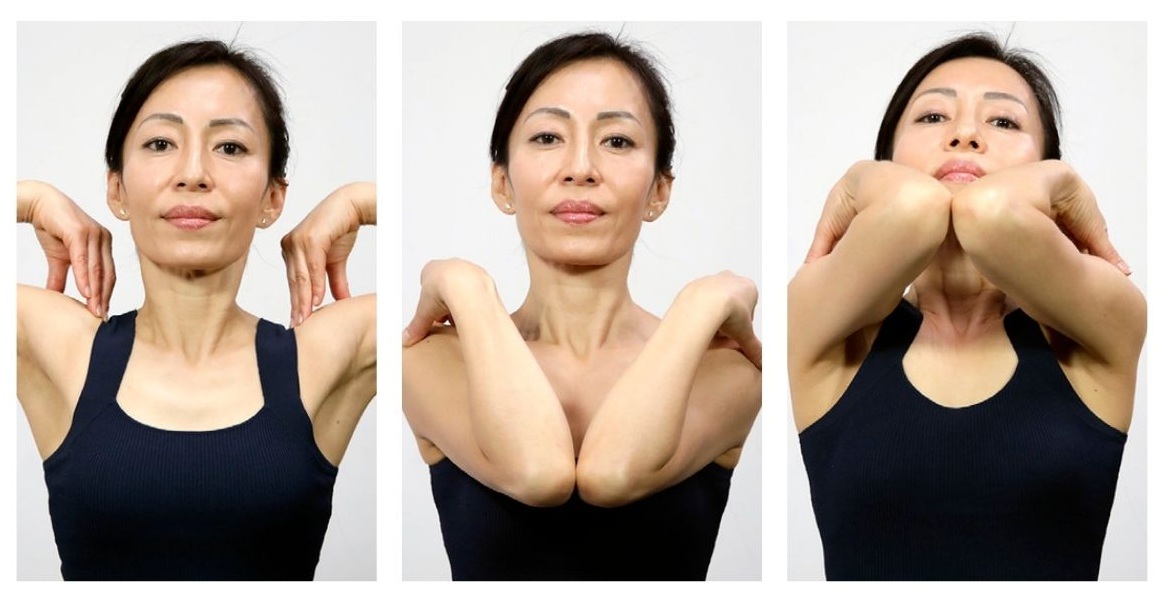
What it does: Corrects rounded shoulders and improves posture, opens the chest and increases shoulder mobility, releases tension from neck and upper back, activates the lymphatic system, deepens breathing, and promotes relaxation.
How to do it:
- Sit tall with relaxed shoulders. Breathe naturally through your nose.
- Place both hands on your shoulders. Push your shoulder blades down.
- Breathe in as you bring your elbows together, then lift them up toward the ceiling. Breathe out as you open your elbows wide and circle them down. Repeat 4 times.
- Reverse the direction. Breathe in as you bring your elbows back and up. Breathe out as you bring them together and down. Repeat 4 times.
- Relax and lower your arms.
2. Double Chin Lift

What it does: Reduces and prevents double chin and turkey neck, tones the front of the neck and jawline, activates the lymphatic system to flush out toxins.
How to do it:
- Sit tall with relaxed shoulders. Breathe naturally through your nose.
- Look up at the ceiling and tilt your head back. Stick your tongue out toward the ceiling and hold for 5 seconds.
- Move your tongue to the right and hold for 5 seconds.
- Move your tongue to the left and hold for 5 seconds.
- Return your tongue to center, then relax and lower your head.
3. Swan Neck

What it does:
Tones and stretches the neck and jawline, helps reduce sagging neck, double chin, jowls, and marionette lines, while activating the lymphatic system to flush out toxins.
How to do it:
- Sit tall with relaxed shoulders. Breathe naturally through your nose.
- Look up and to the right at 45 degrees. Turn your head to follow your gaze. Pucker your lips and hold for 5 seconds.
- Return to center.
- Look up and to the left at 45 degrees. Turn your head to follow your gaze. Pucker your lips and hold for 5 seconds.
- Return to center and relax.
Common Mistakes That Make Turkey Neck Worse
Even with the best intentions, certain habits can work against your progress. I see these patterns often, and just becoming aware of them is half the battle:
Pulling or overstretching: Being too aggressive with neck exercises can weaken muscles and damage skin. Always work gently and gradually.
Skipping posture corrections: If you spend hours hunched over your phone, you reduce the benefits of these exercises. Integrate posture awareness throughout your day. It is as important as the exercises.
Clenching your jaw while exercising: Tensing your jaw during face exercises creates tension. Notice when this happens, breathe, and relax your jaw.
Using the wrong resistance or tools: Using heavy weights or aggressive massage tools on the neck can cause harm. The neck is delicate. Use gentle, controlled movements and light pressure.
Inconsistency: Doing exercises only occasionally will not create lasting change. Your muscles need regular engagement to build and maintain tone. Practice daily, even if only for five minutes.
How Often Should You Do Turkey Neck Exercises?
For best results, practice turkey neck exercises daily for 5-10 minutes.
Think of it like brushing your teeth — a short, consistent practice that becomes part of your routine. You don’t need to spend an hour on this. In fact, shorter, more frequent sessions are better than occasional marathon efforts.
Your muscles also need recovery time. While these are gentle exercises, your platysma and surrounding muscles still benefit from the repair and strengthening that happens between sessions. Daily practice with one rest day per week is a good rhythm.
The key is gentle consistency. You’re retraining patterns, not pushing toward exhaustion. Make it enjoyable, sustainable, and part of your self-care routine — something you actually look forward to.
When to Expect Results
Everyone’s timeline is different, but here’s a general progression I’ve observed across thousands of students:
2 weeks: You’ll notice increased awareness of your neck and jaw. You might feel the muscles engaging more throughout the day, and you may catch yourself correcting your posture more often. This awareness itself is progress.
4-6 weeks: Visible changes start to appear — a slightly firmer jawline, reduced sagging under the chin, and sometimes a smoothing of horizontal neck lines. Others might not notice yet, but you’ll see it.
8-12 weeks: Noticeable improvement that others comment on. Your neck looks more toned, lifted, and defined. The platysma is visibly stronger. This is often when students tell me they feel like themselves again.
Beyond 12 weeks: Continued refinement and maintenance. At this point, the exercises are a habit, and you’re preserving the improvements you’ve made while continuing to support your neck’s appearance as you age.
Results depend on consistency, your starting point, and individual factors such as age, skin elasticity, and overall health. Safe, gentle practice is more effective than aggressive, sporadic attempts. Be patient with the process.
Discover Why Your Neck Ages Faster Than Your Face
These exercises are powerful tools for tightening and lifting your neck. But if you want to truly understand why your neck ages faster than your face in the first place — and the complete approach that addresses the root causes — I have something special for you.
I’m hosting a free masterclass where I’ll reveal:
✨ The 3 real reasons your neck ages faster than your face (and why most people are addressing the wrong issues)
✨ Why exercises alone often aren’t enough — and what’s missing from most approaches
✨ The complete Face Yoga Method that targets all the factors causing turkey neck, not just muscle tone
This isn’t just about exercises. It’s about understanding the full picture so you can create lasting transformation in your neckline.
If you’ve been practicing these exercises and want to take your results to the next level — or if you’re just starting out and want to make sure you’re approaching this the right way — this masterclass will give you the complete roadmap.
Save your spot: Discover The 3 Real Reasons Your Neck Ages Faster Than Your Face with Fumiko.
Turkey neck doesn’t have to be an inevitable part of aging. With consistent, gentle exercises that target the platysma and surrounding muscles, you can create real, visible improvement in your neck’s tone and appearance.
Start with 5-10 minutes a day. Pay attention to your posture. Release tension in your jaw and neck. Allow at least 4-6 weeks of consistent practice before evaluating your results.
Your neck, like the rest of your face, responds to care, attention, and intentional movement. You can make positive changes, and I am here to support you.
Frequently Asked Questions
Can you reverse turkey neck naturally?
Yes, to a significant degree. While you can’t completely reverse severe skin laxity without medical intervention, you can substantially improve muscle tone, reduce sagging, and create a more lifted appearance through consistent Face Yoga exercises.
How long do neck exercises take to work?
Most people notice initial changes within 4-6 weeks of daily practice, with more significant improvement showing up around 8-12 weeks.
Are Face Yoga exercises safe for older adults?
Absolutely. Face Yoga is gentle, low-impact, and safe for all ages. In fact, many practitioners are in their 50s, 60s, and beyond.





This is so helpful! You have taught me so much! I do some exercises & fascial massage in the morning before getting up, & these look amazing to add when up! I love the information about the musculature underneath the face too. It makes everything make so much sense!
So glad this helped! You’re already off to a great start with your morning routine, and it’s awesome to hear the muscle info clicked for you. Keep it up—you’re doing amazing!
May I receive the Face Yoga Method routine, Fumiko was speaking about in the video, please? Thank you.
Hello, Fumiko
I’ve been following you for a long time but, unfortunately, I have a very poor understanding of English. I always try to read your messages and translate fragments that I don’t understand at all, but that won’t help me in the case of following a conference or a course of yours. It’s a shame. I wish there was someone from your school who could do it in Spanish.
Best regards
Lola
Hi Lola,
Thank you for your lovely message and longtime support!
We understand how hard it can be to follow content in another language. While most of our materials are in English for now, offering Spanish support is something we’re looking into for the future.
Feel free to reach out anytime—we’re happy to help clarify things in Spanish when we can!
Un abrazo,
Absolutely stunning.Well done Coach.
Thank you so much! So glad you enjoyed it!
Hey Lola! Click here to get the free Face Yoga video routine now –> https://bit.ly/fym-video-routine